What Head Start Actually Is
Head Start is free early education for children from low-income families, funded federally and delivered by local agencies. It is not only preschool. Enrolled children receive developmental screenings, health and dental checks, meals, and their families get support alongside it.
There are two tracks:
Early Head Start serves children from birth through age two, and pregnant women. Prenatal support, parenting education, then a handover to the infant and toddler track.
Head Start serves children aged three to five. Centre-based or home-based depending on the programme.
Both are free to qualifying families. There is no fee, no sliding scale and no copay.
2026 Income Guidelines
Not sure if you qualify for benefits? Check in under 2 minutes — it's free, private, and shows estimated amounts.
Head Start eligibility runs on the federal poverty guidelines. The 2026 figures took effect on 26 January 2026.
The base rule is straightforward: a family with income at or below 100% of the poverty guideline qualifies. For a family of four in the 48 contiguous states, that is $33,000 a year.
But programmes can also enrol families above that line under certain conditions, and many operate up to 130%.
| Family size | 100% (standard eligibility) | 130% (many programmes) |
|---|---|---|
| 1 | $15,960 | $20,748 |
| 2 | $21,640 | $28,132 |
| 3 | $27,320 | $35,516 |
| 4 | $33,000 | $42,900 |
| 5 | $38,680 | $50,284 |
| 6 | $44,360 | $57,668 |
| 7 | $50,040 | $65,052 |
| 8 | $55,720 | $72,436 |
Add $5,680 to the 100% figure for each person beyond eight. Alaska and Hawaii use higher guidelines.
Income means gross income, before tax. It includes wages, business income, unemployment compensation, pension and annuity payments, and military income, though certain military allowances are excluded.
An important caveat on the 130% column. Enrolling above 100% is not automatic. Programmes generally must exhaust their waiting list first and obtain an approved over-income waiver. Programmes can also enrol a limited share of children above the income limit at their own discretion. So being between 100% and 130% means worth applying, not guaranteed.
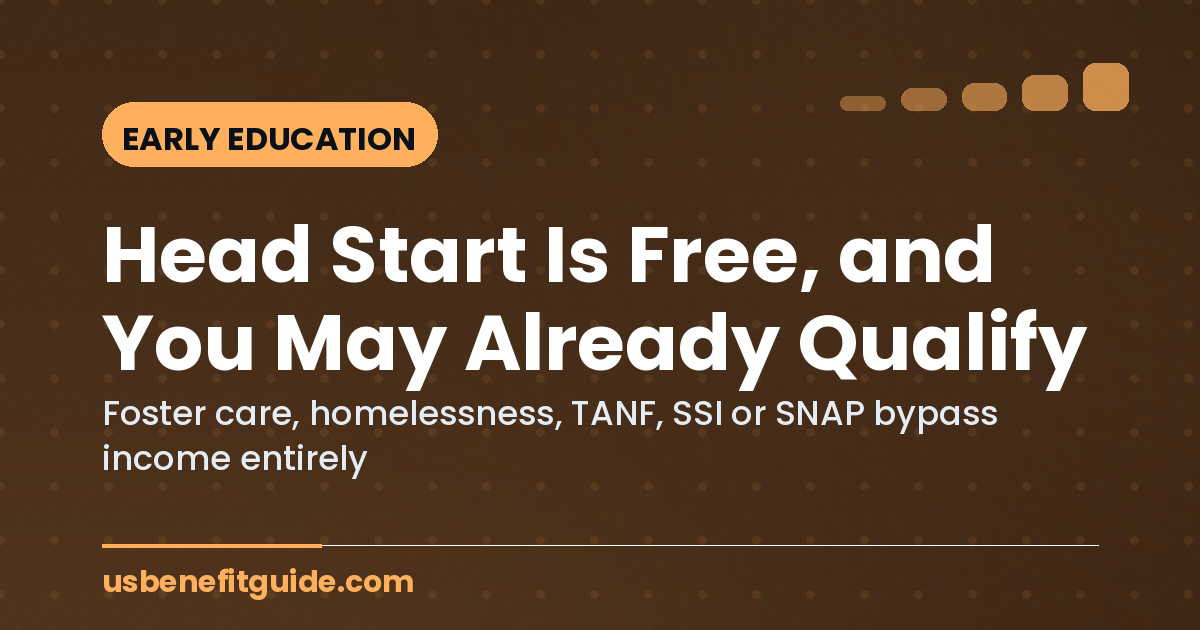
You May Qualify Regardless of Income
This is the part most families miss, and it matters more than the income table.
Federal rules grant categorical eligibility to several groups. These children qualify automatically, with no income test at all:
- Children in foster care, regardless of the foster family’s income
- Children experiencing homelessness, under the McKinney-Vento definition, which is broader than most people assume and includes families doubled up with relatives due to loss of housing
- Families receiving TANF or SSI
- Families receiving SNAP
If any of those apply to your household, income does not enter the conversation. Say so at the first contact, because it changes how the application is processed.
Separately, at least 10% of a programme’s funded enrolment is reserved for children with disabilities eligible under Part C or Section 619 of IDEA. That is a statutory requirement, and enrolment cannot be denied because of a disability.
Applying
Our free checker shows every program you're eligible for with estimated monthly amounts. No signup needed.
See What I Qualify For →🔒 Free · Private · Takes 2 minutesHead Start is not run centrally. Each local programme handles its own enrolment, so you apply directly to the programme serving your area rather than through a state or federal portal.
- Find your local programme. Search by city, state or ZIP code. There may be several, run by different agencies.
- Contact them directly. Ask about openings, waiting lists, and whether they operate centre-based, home-based or both.
- Prepare documents: proof of the child’s age, proof of income for the last twelve months or the previous calendar year, and proof of any public assistance you receive.
- State categorical eligibility up front if it applies. Foster care, homelessness, TANF, SSI or SNAP.
- Expect a waiting list. Slots are funded and finite. Being eligible does not mean being placed.
- Apply to more than one programme if several serve your area. Waiting lists are not shared.
On the income period: programmes look at the twelve months immediately before you apply, or the previous calendar year, whichever more accurately reflects your current situation. If your income dropped recently, say so. The more recent period may be the one that qualifies you.
Changes Being Proposed Right Now
Free and trusted resources to help you take the next step.
Answer a few questions to discover which federal and state benefit programs you may qualify for.
Find Your BenefitsCall 211 or search online to connect with social services, food pantries, and emergency assistance in your area.
Find Local HelpOur free tool screens you for SNAP, Medicaid, housing assistance, disability benefits, and dozens more programs.
Free Eligibility CheckThese are recommended resources based on the topic of this article. We only suggest free, official, or widely trusted services.
There is an open federal rulemaking that would change how Head Start operates, and the comment period is still running.
The Administration for Children and Families published a proposed rule on 7 August 2026 titled Reducing Federal Burden for Head Start Programs. Public comments are due by 6 October 2026.
Among the proposals:
- Removing the housing cost adjustment. Programmes can currently factor high housing costs into an income eligibility determination. The proposal would eliminate that, so eligibility would rest on income alone.
- Removing the age documentation exception. Programmes can currently enrol a child without documentation of age if the family cannot provide it. The proposal would remove that flexibility.
- Eliminating federal selection criteria. Programmes are currently required to weigh specific factors when selecting children, including income, homelessness, foster care status, age and IDEA eligibility. Those requirements would be removed, leaving selection to local discretion.
- Eliminating the screening timeline. The current requirement to complete developmental screenings within 45 or 90 days of enrolment would go. The screenings themselves remain required by statute.
- Eliminating the monthly mental health consultation requirement.
The 10% disability set-aside comes from the Head Start Act rather than regulation, so it is not affected.
None of this is final. If it matters to your family, the comment period is open until 6 October 2026 and anyone can submit.
Separately, ACF has issued guidance on how it reviews requests from programmes to reduce their funded enrolment. That is worth knowing if your local programme has fewer slots than it did a few years ago.
What You Get Beyond the Classroom
Families often compare Head Start with state pre-K or transitional kindergarten and choose the one with less paperwork. That is understandable, but it misses what Head Start includes that school-based programmes typically do not:
- Developmental, hearing, vision and dental screenings
- Meals and snacks meeting federal nutrition standards
- Structured parent engagement, which is built into the model rather than optional
- Family support services and referrals to other assistance
- Services for children with disabilities, with a guaranteed share of places
Most Head Start children are also Medicaid-eligible, and Medicaid’s EPSDT benefit independently guarantees periodic screenings. So the two work together.
Head Start Unlocks Other Things
Ready to apply for benefits?
Thousands of people miss benefits they qualify for. Check now and see your estimated monthly amount.
Check My Benefits in 2 Minutes →Enrolment has knock-on effects worth knowing.
School meals. Children enrolled in Head Start are directly certified for free school meals without an application when they reach school age. Our school meals guide covers how direct certification works.
The same income threshold opens other doors. The poverty guidelines driving Head Start eligibility also drive SNAP, WIC, LIHEAP and others. A family that qualifies for one usually qualifies for several.
Our WIC guide is the natural companion for families with children under five, and our SNAP eligibility guide covers the programme that also grants automatic Head Start eligibility.
Frequently Asked Questions
What is the income limit for Head Start in 2026?
At or below 100% of the federal poverty guideline, which is $33,000 a year for a family of four in the 48 contiguous states. Many programmes also enrol families up to 130%, or $42,900 for the same family, though that requires the waiting list to be exhausted and a waiver approved.
Can I qualify if I earn too much?
Possibly. Children in foster care, children experiencing homelessness, and families receiving TANF, SSI or SNAP qualify automatically regardless of income. Programmes can also enrol a limited number of over-income children at their discretion.
What ages does Head Start cover?
Early Head Start covers birth through age two, plus pregnant women. Head Start covers ages three to five.
Is Head Start free?
Yes. No fees, no sliding scale, no copay for qualifying families.
How do I apply?
Directly to the local programme serving your area. There is no central application. If several programmes serve your area, apply to each, because waiting lists are not shared.
How long is the wait?
It varies enormously by area. Slots are funded and finite, so eligibility does not guarantee a place. Apply as early as you can, including before your child reaches the age band.
Is Head Start changing?
A proposed rule published 7 August 2026 would remove several federal requirements, including the housing cost adjustment for eligibility and the specific criteria programmes use to select children. Comments are open until 6 October 2026. Nothing is final.
Head Start or transitional kindergarten?
TK usually involves less paperwork and no strict income test. Head Start includes medical and developmental screenings, meals, family support and structured parent engagement that school-based programmes generally do not match. If your child qualifies for both, compare what each actually provides.
Where to Start
Find your local Head Start programme and call them. Ask two things: whether they have openings, and whether your household qualifies categorically through foster care, homelessness, TANF, SSI or SNAP.
If the answer to the second is yes, income does not matter and the conversation changes immediately.
Not sure what else your family qualifies for? Our free eligibility checker takes about two minutes.